Reverse Sankaku: innovative and rare but it works
There are techniques in judo that follow a clear textbook structure. Then there are techniques that live in the grey area between structure and improvisation. The reverse sankaku belongs firmly in the second category.
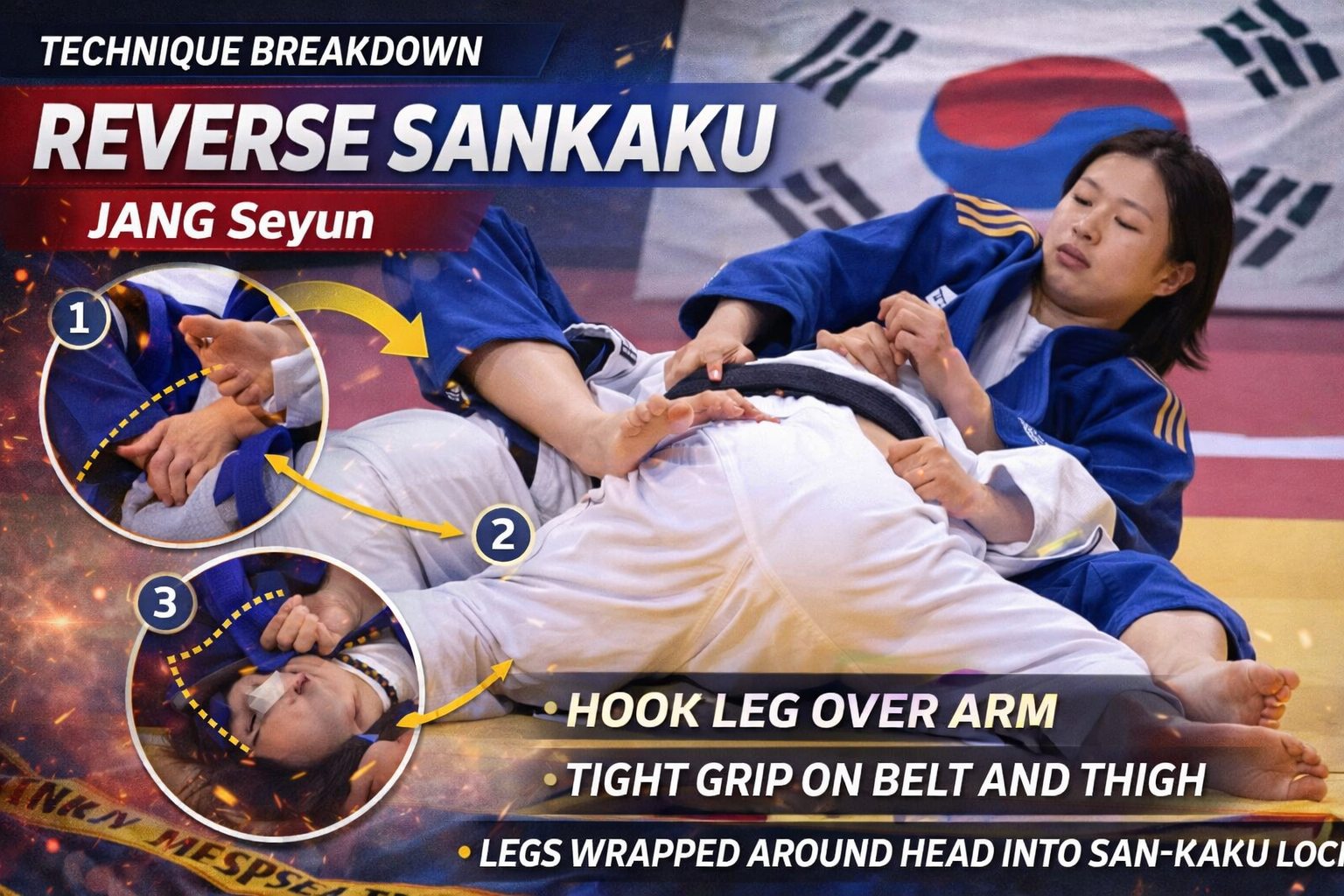
In modern contest judo, reverse sankaku has become an increasingly popular attacking tool in transition. Typically, the sequence begins when tori threads the right leg over uke’s left shoulder or armpit, trapping the upper body. From there, the classic version requires tori to tuck the left foot under the right knee, forming a tight triangle configuration that locks the torso and allows control to develop into osaekomi, juji-gatame or even a turnover into strangle.
That is the convention.
But as we know in high-level judo, convention is often just a starting point.
Jang Seyun’s unconventional twist
What makes Jang Seyun so interesting is that she reverses the mechanics. Instead of tucking the left foot under the right knee, she tucks the right foot under the left knee.
At first glance, it looks wrong. The angles seem inverted. The triangle appears less secure. But once the position settles, the control is undeniable.
Why does it work?
Because sankaku control is not about which foot goes where. It is about hip line dominance. If tori can compress uke’s shoulder line, elevate the trapped arm and prevent rotation, the configuration becomes secondary to the pressure.
Jang’s variation alters the angle of force. Rather than clamping directly downward, her version creates a diagonal compression that disrupts uke’s base differently. In some cases, it even makes it harder for uke to roll out in the traditional escape direction.
It is unconventional, yes. But it is mechanically sound.
The Italian precedent
We have seen creative reverse sankaku adaptations before. Francesca Milani has demonstrated versions that blur the line between turnover and submission threat. In Milani’s case, the entry often flows directly from failed tachiwaza, catching opponents in mid-transition.
The difference with Jang is intent. Milani’s reverse sankaku often looks like a natural extension of groundwork pressure. Jang’s feels like a deliberate structural choice.
This distinction matters. It shows evolution rather than improvisation.
Why reverse sankaku works in modern judo
Modern rules reward continuity. The faster tori can convert from standing attack into groundwork control, the greater the scoring opportunity.
Reverse sankaku thrives in this environment because:
- It controls the upper body without needing full hip rotation.
- It prevents uke from simply turning belly-down to avoid osaekomi.
- It creates immediate threat of juji-gatame or sode-guruma-jime variations.
- It destabilises posture before uke can re-establish guard.
Unlike classical sankaku, which often requires more setup time, the reverse variation can be applied mid-scramble.
That makes it a contest weapon.
Defying convention at elite level
There is a tendency in coaching to present technique as fixed. Right leg here. Left foot there. Angle at 45 degrees. But elite competition shows that effectiveness depends less on symmetry and more on pressure alignment.
Jang’s opposite tuck is a reminder that judo remains adaptable. If the hips are correctly positioned and the shoulders are trapped, the triangle functions.
The body does not care about tradition. It responds to force.
The broader lesson
Reverse sankaku is not simply a trendy transition move. It represents a wider technical shift in women’s judo. Athletes are no longer relying purely on classical groundwork sequences. They are hybridising, borrowing, adjusting and personalising.
What we see with Jang Seyun is not rebellion against orthodoxy. It is refinement through experimentation.
And perhaps that is the real takeaway.
In judo, principles matter more than patterns.
Control the line. Control the shoulder. Compress the space.
Whether the left foot tucks under the right knee, or the right under the left, is secondary.
If it works, it works.
Back to the overview