
Anton Geesink and the birth of global judo
If you want to understand when judo truly became a global sport, there is one name you cannot avoid. Anton Geesink.
Before him, the assumption was simple. Japan invented judo, Japan dominated judo, and Japan would always dominate judo. Geesink shattered that idea on the biggest stage imaginable.
A giant arrives
Geesink discovered judo at 14 after watching a demonstration. Within just a few years he was already making waves. At 17, still only a brown belt, he took silver at the 1951 European Championships. A year later he was European champion.
It helped that he was enormous for the era. At 198 cm he towered over most opponents. But reducing Geesink to size alone misses the point. His judo was technical, thoughtful and constantly evolving.
As a teenager he built his game around foot sweeps and uchimata. Later, during repeated training trips to Japan, he sharpened techniques like sasae-tsurikomi-ashi, which would become one of his most dangerous weapons.
Learning the Japanese way
The Dutchman did something rare at the time. He travelled to Japan and immersed himself in their system, often training there for months at a time.
Early World Championships showed both promise and frustration. In 1956 he lost in the semi-final to Yoshihiko Yoshimatsu. In 1958 he was stopped in the quarter-final by Kimiyoshi Yamashiki.
But Geesink kept improving. At the 1961 World Championships everything clicked. He defeated three elite Japanese judoka on his way to gold: Akio Kaminaga, Hitoshi Koga and Koji Sone. For a European to do that at the time was extraordinary.
Yet Geesink himself was not satisfied.
He believed his groundwork was not good enough.
The newaza obsession
Back home he began drilling sankaku relentlessly. Later he spent three months at Tenri University in Japan, famous for its newaza training.
Geesink became outspoken about what he saw in traditional judo training.
“They are too romantic with their insistence on deciding the contest by a spectacular throw.”
His philosophy was simple. Sixty percent groundwork. Forty percent standing.
That balance would soon make him the most complete heavyweight in the world.
Tokyo 1964: the fight that changed judo
By the time the Tokyo Olympics arrived, Geesink was 30 but at the peak of his powers.
The Open division carried enormous symbolic weight for Japan. Winning it was seen as essential.
Fate produced the ultimate storyline.
Geesink and Japanese star Akio Kaminaga ended up in the same preliminary pool. Geesink blasted through Britain’s Alan Petherbridge in seven seconds with sasae-tsurikomi-ashi, then edged Kaminaga on decision.
Kaminaga fought his way back through the repechage. The dream final was set.
The silence in Tokyo
The final began cautiously. Both men knew each other well.
Midway through the contest Geesink nearly scored with his trademark foot sweep. Kaminaga answered with tai-otoshi. The tension inside the arena was immense.
Then the moment came. Geesink dragged Kaminaga into groundwork, turned him onto his back and locked in kesa-gatame. Thirty seconds later it was over.
The Japanese had lost the Open gold in their own Olympics.
The moment of respect
As Geesink stood up, a Dutch teammate rushed onto the mat to celebrate.
Geesink waved him away. He wanted to bow properly to Kaminaga first. It was a small gesture but one that earned huge respect in Japan.
Many Japanese athletes were devastated. Some were openly crying. Headlines the next day were brutally honest: Japan had failed in its real mission, defeating Geesink.
Why the win mattered for judo
Ironically, the result helped the sport enormously. Until then, many people viewed judo as essentially Japanese. Geesink’s victory proved it could belong to the world.
Without that moment, some historians believe judo might not have remained in the Olympic programme.
As Dutch federation leader Jos Hell later said, Geesink’s win was not just a national triumph. It was a victory for global judo.
The years after
Geesink kept winning. He took another world title in 1965 and finished his career with an astonishing 21 European titles before retiring in 1967. Afterwards he explored new paths, even working as a professional wrestler in Japan during the 1970s.
He also remained influential in judo politics. In 1986 he proposed introducing the blue judogi, a change eventually adopted in 1997.
Honours followed from both Europe and Japan, including the prestigious Order of the Sacred Treasure.
A complicated legacy
Like many influential figures in international sport, his later career was not without controversy. As an IOC member he became linked to the Salt Lake City Olympic bid scandal, though he was ultimately cleared and allowed to continue serving. Despite that episode, his impact on judo remained undeniable.
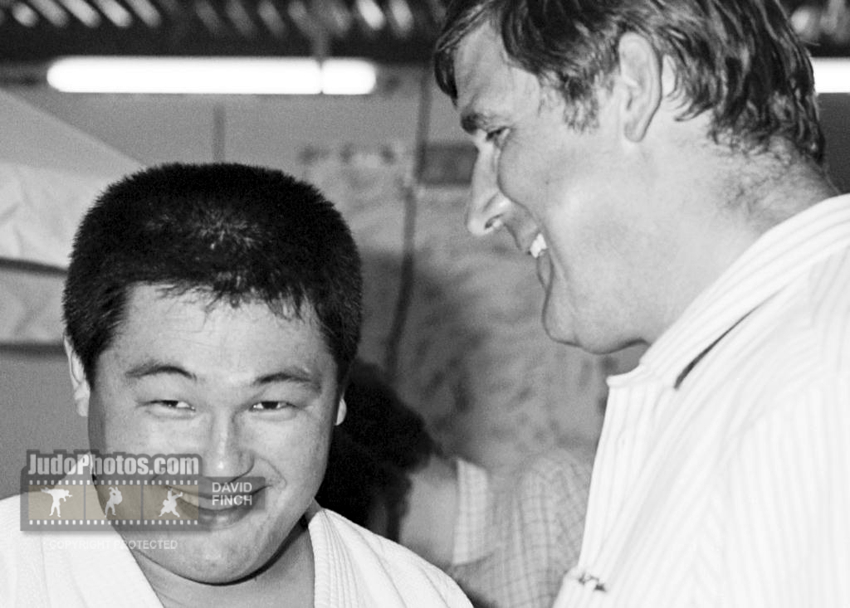
The man who opened the door
Anton Geesink passed away in 2010, but his legacy still echoes through the sport.
Before him, defeating Japan at the highest level felt impossible. After him, every judoka in the world believed it might just be possible and that belief changed judo forever.

Back to the overview