
Slovenia’s Olympic magical golden story
When people talk about small countries punching above their weight in judo, Kosovo is usually the first name mentioned. Fair enough. But Slovenia deserves to be in that conversation every single time.
Like Kosovo, Slovenia is a Balkan country with around two million people. Like Kosovo, it has produced three Olympic judo champions. And like Kosovo, all three champions are women.
That is where the similarities end and the really interesting part begins. Watch the video here via JudoCrazy
Slovenia did something far more specific than the women of Kosovo, honestly, far stranger. All three Olympic gold medals came in the same weight class. Women’s under 63kg. And they were spread across four Olympic cycles.
Same division. Same country. Different generations. Same outcome.
That does not happen by accident.
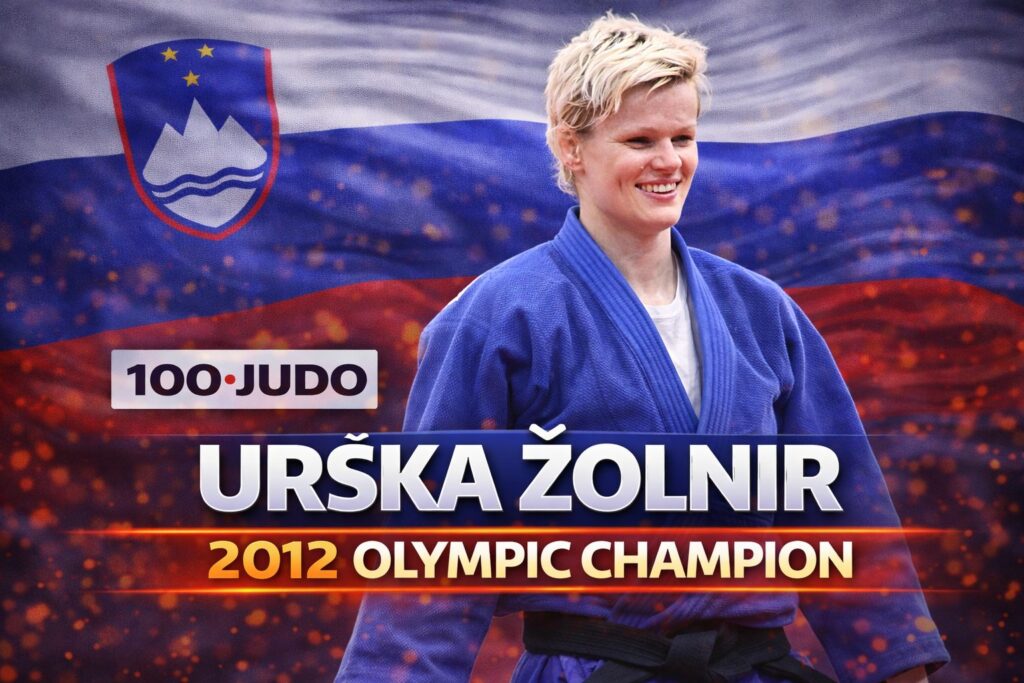
Urska Zolnir: the one who started it all
Every story needs a starting point. For Slovenia at -63kg, that point is Urska Zolnir.
What makes Zolnir’s career special is how unconventional it was. Her first major international breakthrough did not come at a World Championship or a European Championships. It came at the Olympic Games. In 2004, she entered the Athens Olympics as a wildcard and walked away with a bronze medal. That alone would have been a career for most athletes.
She kept building. In 2005, she won her first World Championships bronze, adding another in 2011. At the European Championships, her first medal came in 2007 with silver, followed by gold in 2009. On the IJF World Tour, she announced herself properly with gold at the 2008 Tokyo Grand Slam, eventually collecting four IJF gold medals.
The peak came in London 2012. Zolnir won Olympic gold and did what very few athletes manage. She left on top. Apart from a brief return for the 2014 European Team Championships, where she won both of her contests, her competitive career ended exactly where every judoka dreams of ending it.

Tina Trstenjak: the standard setter
If Zolnir opened the door, Tina Trstenjak kicked it wide open.
From the same club as Zolnir, Trstenjak went on to become the most decorated Slovenian judoka of all time. Her numbers on the IJF World Tour alone are ridiculous. Fourteen gold medals. Not appearances. Not podiums. Golds.
Her first IJF medal came in 2012 at the Qingdao Grand Prix, while Zolnir was still active. From there, she just kept stacking results. Her first European Championships medal arrived in 2013 and she would go on to win the European title three times.
At the World Championships, she completed the full set. Bronze in 2014. World champion in 2015. A world silver later on. Every colour. No gaps.
Her defining moment came at the Rio 2016 Olympic Games. In the final, she faced France’s Clarisse Agbegnenou, her long time rival. Trstenjak won when it mattered most and became Olympic champion. The rivalry continued all the way to Tokyo 2021, where Agbegnenou took the rematch. After those Games, Trstenjak stepped away from competition, her legacy secure.

Andreja Leski: the quiet finisher
Then came Andreja Leski, from a different club, a different path and a different kind of career arc.
Leski’s rise was slower, quieter and far less hyped. Her first IJF World Tour medal was a bronze at the 2016 Ulaanbaatar Grand Prix. Her first gold came two years later in Düsseldorf. In total, she would collect four IJF gold medals.
At continental and world level, the progress was steady. European bronze in 2021. European gold in 2023. World Championships bronze in 2021 and again in 2023. Always there. Always close. Rarely labelled the favourite.
Going into the Paris 2024 Olympic Games, Leski was a contender, but not the obvious pick. She had not won the World Championships, Europeans or a Grand Slam that year. But Olympic judo does not care about recent form when the moment arrives.
In Paris, everything clicked. In the semi final, she faced Agbegnenou, who had beaten her five times before. This time was different. Leski won when it counted, broke the pattern and carried that belief into the final.
Slovenia had its third Olympic champion at -63kg.
Same weight, same result, different paths
Three Olympic champions. Same division. Different generations. Different personalities. Different career shapes.
That is not coincidence. That is structure, patience and belief in a system that knows exactly what it is doing.
Kosovo showed the world that a small country can dominate across multiple weights. Slovenia showed something else. That a single weight class, done right, can become a factory for Olympic gold.
At -63kg, Slovenia did not just win medals. It built a legacy.

Back to the overview