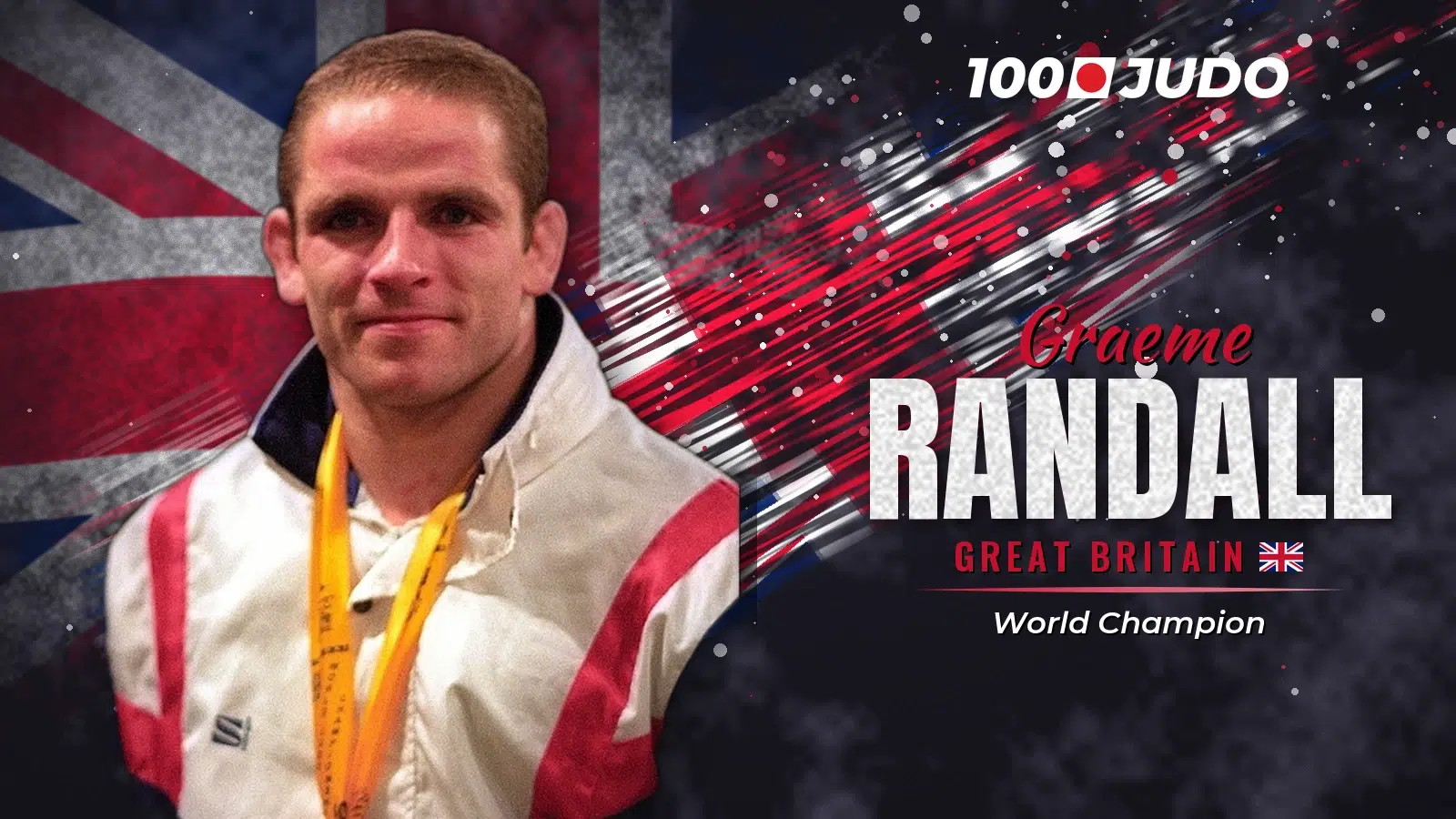
Graeme Randall and the night in Birmingham
With 18 seconds left in the U81kg final at the 1999 World Championships in Birmingham, Graeme Randall knocked Farkhad Turaev of Uzbekistan to the mat and turned him into a hold. Randall was already a waza-ari ahead from a kata guruma. When the bell went, the Scot was world champion, the first British man to win a world title since Neil Adams in 1981.
“It feels absolutely fantastic,” Randall said as he left the mat, according to the JudoInside report from that day. “With a crowd like that I had to do it for them.”
The Austrian in the way
To understand Birmingham you have to start in Paris. At the 1997 World Championships, then fought at U78kg, Randall beat Johan Laats, Soso Liparteliani, Aleksander Sorsak, Sergio Doménech and Flávio Canto. Then Austria’s Patrick Reiter beat him in the bronze medal contest and Randall finished fifth.
Reiter was the problem he could not solve. JudoInside records four meetings between the two, and the Austrian won three of them. The only time Randall beat him came on the biggest day of his career.
Ippon, ippon, Reiter
Born in Edinburgh on 14 March 1975 and coached by Billy Cusack, Randall arrived in Birmingham with his first major senior medal, European bronze in Bratislava that May. He opened with morote seoi nage for ippon against Finland’s Matti Lattu, then did the same to Switzerland’s Sergei Aschwanden, a rival he would beat in three of their four contests.
Round three was Reiter. Randall won, and afterwards called it his hardest fight. The quarter final against Kazakhstan’s Ruslan Seilkhanov lasted about 25 seconds before a te guruma ended it. In the semi final he threw Portugal’s Nuno Delgado for ippon with kata guruma, reversing the result of their European semi final earlier that year. The home crowd now had a man in the final; the same JudoInside report notes he was the first British male medallist of any colour in twelve years.
The final followed the pattern of his day. Randall attacked from the start against Turaev, kept scoring and finished with the hold down that sealed it. The 1999 World Championships in Birmingham were his.

After the title
In the same interview he looked ahead to the Sydney Olympics: “I’m going there to win gold!” It did not happen. In Sydney he beat Abdesselem Arous and then lost in the second round to Iran’s Kazem Sarikhani. At the 2001 World Championships in Munich he reached the semi final, lost to Korea’s Cho In-Chul and then the bronze contest to Elkhan Rajabli, another fifth place at world level.
He still had a title left in him. In 2002 Randall won Commonwealth Games gold, adding to two British Open wins and a stack of Scottish and British titles. The JudoInside career piece on his 51st birthday lists the athletes he admired as Bachir Varaev and Kosei Inoue, the Japanese star 100judo profiled in The rise and legacy of Kosei Inoue.
Randall was a right hander who often met left handed opponents and built his judo on initiative and fitness. In Birmingham that approach, with a home crowd behind him, was enough to beat the one man who usually beat him.
Back to the overview