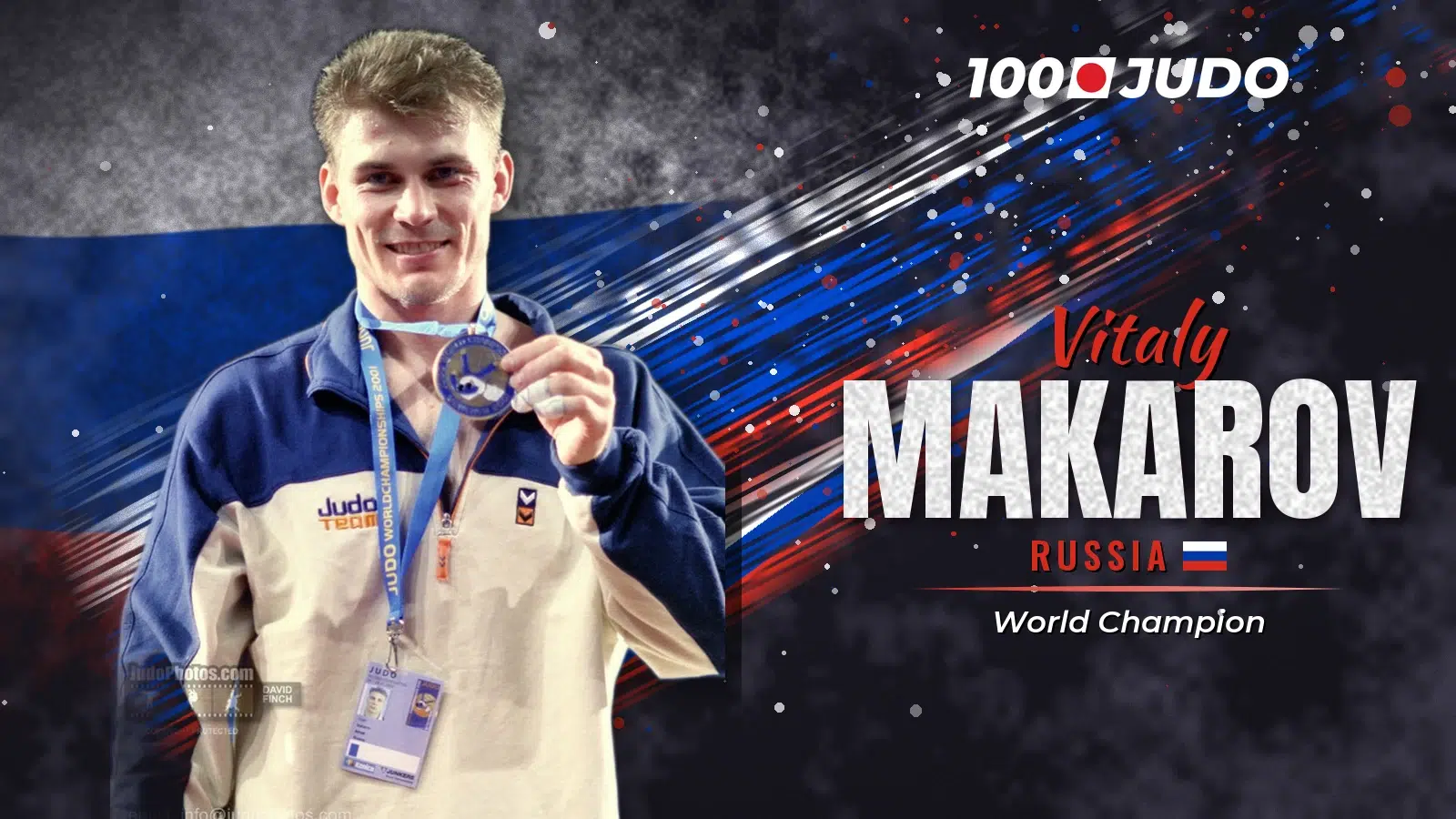
Vitaly Makarov and the uchi-mata of Munich
Going into the last minute of the 2001 world final in Munich, Vitaly Makarov led Yusuke Kanamaru by two yuko. The Japanese kept pressing, the pair drifted towards the edge of the mat, and Makarov turned in for one more uchi-mata. This one put Kanamaru flat on his back for ippon.
It was the right throw against the right man. Kanamaru, a morote-seoi-nage specialist, had beaten the Russian in the final of the Budapest World Cup only a few months earlier. That pattern runs through the whole career of Vitaly Makarov: a defeat, a long look at what went wrong, and an answer the next time the same door opened.
A final that could go either way
JudoInside’s account of the match describes an all-action contest in which both men kept trading their favourite attacks. Makarov opened with uchi-mata in the first seconds, Kanamaru replied with a dropping morote-seoi-nage, and neither changed his menu much after that. The Russian took his first yuko by countering a seoi-nage and the second with a well-timed foot sweep before the final throw settled it. Kanamaru bowed with a smile, and the two became friends after their careers.
The title at the 2001 World Championships in Munich came after a run of near misses. Makarov, born on 23 June 1974, had been world junior champion at U71kg in Cairo in 1994. In Birmingham in 1999 he reached his first senior world final and lost it to Jimmy Pedro of the United States. In May 2000 Michel Almeida of Portugal beat him in the European final in Wroclaw, and at the Sydney Olympics that September he went out in his opening contest against Askhat Shakharov of Kazakhstan. Six wins in one day in Munich answered all of that.
Fernandes, and a second look
The same reflex showed against Daniel Fernandes. At the 2003 World Championships in Osaka the Frenchman beat Makarov in the semi-final, leaving him to take bronze against Egamnazar Akbarov of Uzbekistan. Eleven months later they met again in the Olympic semi-final in Athens, and this time Makarov won. The final against Lee Won-hee of South Korea went the other way, and he left Athens with silver at the age of 30.
That completed a set of world medals in all three colours, alongside European silver in 2000 and bronze in 1999, plus three European Club Cup titles between 2001 and 2005.
The man beside Gamba
His second career kept him on the same mats. JudoInside describes him as the right hand of Ezio Gamba during the most successful era of Russian judo, the team manager who stepped in to lead the squad whenever the Italian was absent. When JudoInside met him at the Grand Slam in Ulaanbaatar in 2022, where he spent his birthday with the team, he was Team Director and busier than ever, because Gamba had left the team due to illness. His JudoInside profile records that he later succeeded Gamba as head coach and stepped down in May 2026.

Inside the team he is known as Vito, and his family home has long been in Spain, from where he travelled to tournaments for most of the year. JudoInside’s birthday portrait of the Russian at 52 follows that coaching road in more detail. Ask about him on the circuit, though, and the Munich final still comes up first: two men who knew each other’s judo by heart, and the Russian who found the gap with a minute to go.
Back to the overview