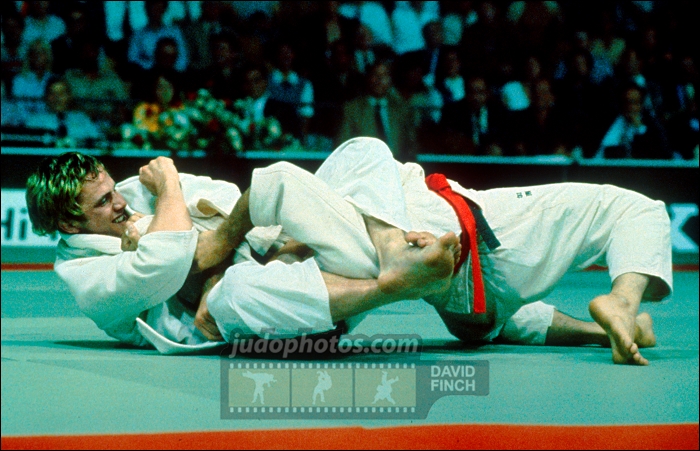
The Ingenuity of the Adams Armlock
In 1978, Neil Adams was a rising star brimming with confidence. He was expected to win the 1978 British Open but in the final he was beaten in newaza by Jean-Pierre Gibert of France who caught him with a sankaku.
That defeat in groundwork was a devastating blow to Adams. But it made him resolve to never be beaten in newaza again. His groundwork move of choice however was not sankaku but juji-gatame.

At the time, the prevailing method of rolling uke over into a juji-gatame position was a move made popular by the Soviet player Alexander Iatskevich. In that version, tori weaves weaves his arm through uke’s arm, leans towards uke’s legs and takes hold of one of uke’s legs to aid in the roll. By pulling on uke’s leg, tori is able to force uke to make a forward roll. Tori ends up on top in a juji-gatame position. This was the standard way juji-gatame was being done in competition.

Adams based his juji-gatame roll on the Iatskevich version but he added one very important tweak, which further improved the roll. Instead of just weaving his arm through uke’s arm, Adams adopted a Figure-4 grip on uke’s arm.
The beauty of this approach is its versatility. It allowed Adams to lean towards uke’s legs, just like Iatskevich did, and force uke to do a forward roll into the juji-gatame position. But it also allowed him to alternatively, lean towards uke’s head and force uke to do a backwards roll, into the juji-gatame position.


This versatility was in full display in the -78kg final of the 1981 World Championships where Adams defeated Jiro Kase of Japan with an armlock. After a failed seoi-nage attack, Adams climbed on top of Kase’s back to begin his armlock attack. After securing the Figure-4 grip, Adams leaned towards Kase’s head and momentarily rolled him over, but Kase managed to get back into the turtle position. Adams then leaned towards Kase’ legs instead to do the roll. This time he was able to roll Kase into the juji-gatame position, and the rest, as they say, is history.

Adams’s stunning victory inspired many players to use juji-gatame as a way to win on the ground. Ironically, the way most players do the juji-gatame roll today is still the Iatskevich version. When you see a juji-gatame roll being done on the IJF circuit, there’s a high chance it’s the Iatskevich version, which is easier to learn. Perhaps that is the reason why it’s so popular. But there’s no doubting the Adams version is more versatile, as tori can roll towards the legs or towards the head. This makes it much harder for uke to prevent the roll.
If you like this article, consider becoming a patron so we can make more content like this for you.
Back to the overview