Kotsoiev’s Arm Lock Controversy at Europeans
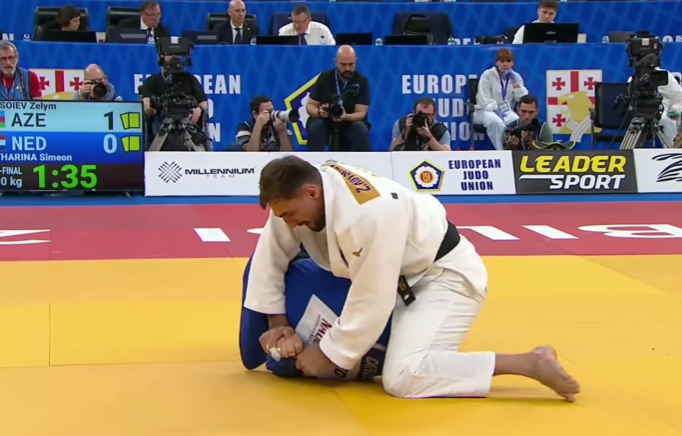
A controversial moment involving Zelim Kotsoiev has triggered widespread discussion in the judo community following the 2026 European Championships, after the Azerbaijani was disqualified in his semifinal for applying what referees judged to be an illegal joint lock against Simeon Catharina. The hansoku make not only ended the match immediately but also removed him from the competition entirely, meaning he was unable to return for a bronze medal contest, which added further weight to the decision.
The situation unfolded during a groundwork exchange where Kotsoiev applied a lock that at first glance resembled a variation of ude garami. However, the referee reacted without hesitation and ruled that the technique placed pressure on the shoulder rather than the elbow, which under current IJF rules is not permitted. In judo, joint locks must clearly target the elbow, and any action that intentionally stresses the shoulder joint is considered dangerous and therefore illegal.
What makes the situation more complex is the ongoing confusion around these types of techniques. Some observers felt the action could still be interpreted as a legitimate ude garami, especially since similar positions are sometimes allowed to continue when applied with a figure four grip using both hands. In those cases, the pressure can remain focused on the elbow and lead to a controlled submission. In contrast, when the arm is lifted or pulled upward in a way that shifts the force into the shoulder, referees are expected to intervene. The difficulty is that the difference between these scenarios can be subtle and difficult to judge in real time.
The decision quickly sparked a wave of reactions from within the sport. Many supported the referee and felt the call was correct, stating that the technique clearly attacked the shoulder and therefore deserved a direct disqualification. Others pointed to the core principle behind the rules, explaining that legality depends entirely on which joint is being stressed, regardless of the grip used. At the same time, several voices highlighted the inconsistency in how these situations are handled, noting that similar techniques are sometimes allowed to continue and calling for clearer guidance from the IJF on whether variations commonly known as Kimura or Americana should be accepted in judo competition.
There were also tactical questions raised about the situation, with some wondering why Kotsoiev chose to pursue the submission rather than transition into a hold down position, which could have been a safer scoring option. A few reactions were more critical of the technique itself, suggesting it did not align with the spirit of judo, while others praised the referee for making a firm and immediate decision without hesitation.
Beyond the single match, the incident reflects a broader issue within modern judo, where the evolution of groundwork and the influence of other grappling styles have created more overlap in techniques and interpretations. While the rules are clear in principle, stating that only the elbow joint may be attacked, the practical application in fast moving competition continues to create grey areas. As a result, calls are growing louder for the IJF to provide more detailed clarification to ensure consistency for athletes, coaches and referees alike.
For Kotsoiev, the outcome is particularly harsh, as the disqualification not only cost him a place in the final but also removed any chance of fighting for a medal. For the sport, however, the moment has become another example of how fine the line can be between a legal submission and an illegal action, and how important clear interpretation remains at the highest level of competition.
Back to the overview